Indonesia remains one of the most attractive destinations for families who want to relocate for education, lifestyle, and long-term stay. Many parents choose Bali and other parts of Indonesia for school-based relocation and then apply for a residence permit (KITAS) for the child and eligible family members.
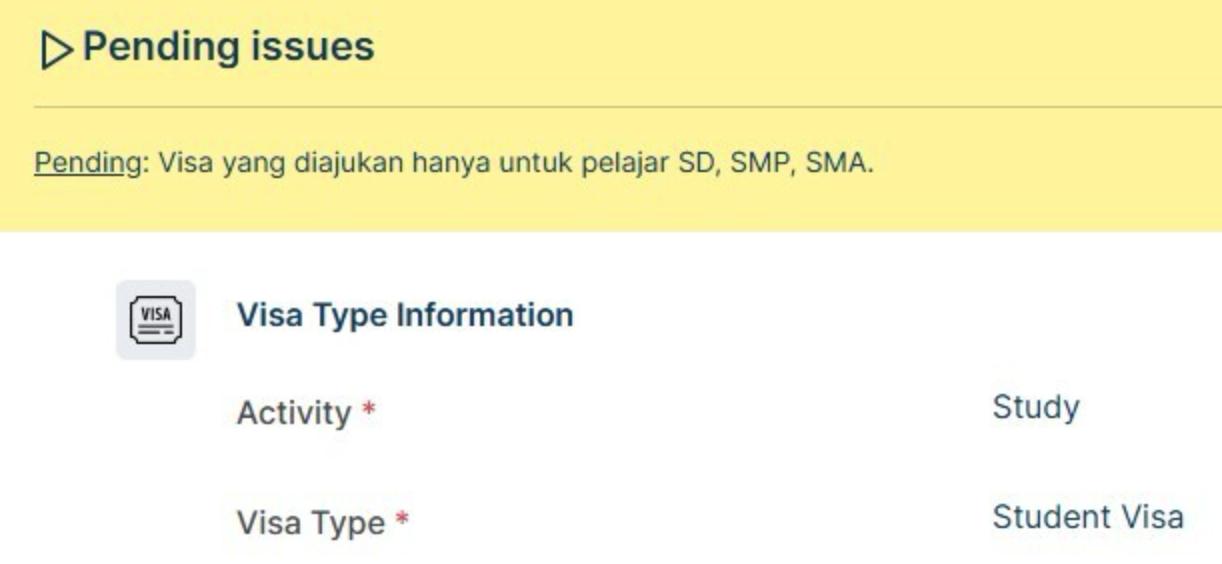
However, on 8 June 2026, we received a practical update from the Indonesian immigration portal showing that the E30A Student Visa / Student KITAS is now being accepted only for students in specific school levels: SD, SMP, and SMA.
This is important because, in previous practice, kindergartens, preschools, and similar early education institutions were often used as the basis for a student visa application. As of now, this interpretation has changed, and families planning relocation to Indonesia should follow the current immigration practice.
If you are planning to move to Indonesia for your child’s education, or for university studies, or if you want to arrange Parent and Sibling KITAS options, this article explains the current situation in a simple and practical way.
Important note from 8 June 2026
Based on the current immigration portal validation and the pending notice we received on 8 June 2026, the E30A Student Visa / Student Residence Permit KITAS is currently accepted only for students enrolled in the following levels of education:
- SD – Sekolah Dasar (Elementary School / Primary School)
- SMP – Sekolah Menengah Pertama (Junior High School)
- SMA – Sekolah Menengah Atas (Senior High School)
This means that kindergarten, preschool, nursery, playgroup, early years, and other levels below Elementary School are currently not accepted as the main basis for an E30A Student Visa application under the present portal interpretation.
It is important to understand that immigration rules in Indonesia can evolve. There is often a difference between the public visa description and the practical interpretation applied inside the system. For now, we follow the current rule exactly as it is being enforced.
What is E30A Student Visa?
E30A is the Indonesian student visa category used for school-level education. It leads to a Student Residence Permit KITAS and is commonly used when a child studies in Indonesia at school level.
Available formats include:
- E30A – Student Visa for 1 Year – Student Residence Permit KITAS
- E30A – Student Visa for 2 Years – Student Residence Permit KITAS
- E30A – Student Visa for 4 Years – Student Residence Permit KITAS

Who can currently use E30A?
Based on the current practice from 8 June 2026, E30A is now intended for school students whose programme is clearly classified as SD, SMP, or SMA.
In practical terms, this usually means the following approximate age range:
- SD / Elementary School – approximately 6 to 12 years old
- SMP / Junior High School – approximately 12 to 15 years old
- SMA / Senior High School – approximately 15 to 18 years old
So yes, for most families, the practical conclusion is that E30A now generally fits children from about 6 to 18 years old.
However, the most important factor is not only the age. The key issue is the official education level stated by the sponsor school in the acceptance documents. If the school’s acceptance letter clearly places the student in a level equivalent to Primary School / Sekolah Dasar, Junior High School / SMP, or Senior High School / SMA, the application is much more aligned with the current immigration interpretation.
Is it only SD, SMP, and SMA, or can the framework be wider?
This is a very important question. The current pending notice specifically refers to SD, SMP, and SMA. So the safest interpretation is to treat these three levels as the core accepted categories for E30A.
At the same time, some schools in Indonesia or international schools may use different programme names. In that case, what matters is whether the programme can be clearly positioned as equivalent to:
- Primary / Elementary level
- Junior secondary level
- Senior secondary level
So in practice, the framework can be a little broader only if the school can clearly classify the student’s programme within one of those accepted school levels and reflect that properly in the documents.
For example, if a school uses international wording but the student is still in a programme equivalent to Sekolah Dasar, that may still fit. But if the child is in preschool, kindergarten, nursery, playgroup, or early years, then under the current practice this is no longer a safe basis for E30A.
What changed on 8 June 2026?
Technically, the public description of E30A did not suddenly become very different. The visa category still remains a student visa for study in Indonesia. What changed is the practical interpretation and portal-level enforcement.
Before this update, kindergartens and similar institutions were often accepted in practice as the educational basis for E30A applications. On 8 June 2026, we received a pending notice stating that the application is only for pelajar SD, SMP, SMA. From that point, we must follow the rule as it is currently being applied.
This is how migration practice often works in Indonesia: the general visa description may stay the same, but the operational interpretation can change, and agencies must act according to what is currently accepted.
Can kindergarten students still get a KITAS in Indonesia?
This is one of the biggest concerns for families. At the moment, the answer is:
Kindergarten or preschool is currently not accepted as the main basis for an E30A Student Visa application.
So for now, families should not assume that they can simply place a child in kindergarten and then obtain an E30A student KITAS for the child and residence permits for the whole family based on that school level.
In other words, under the current practice, it is no longer enough for a child to attend kindergarten in order to build the standard school-based immigration route for the entire family.
At the same time, migration law and immigration practice in Indonesia are not static. Rules, interpretation, and internal procedures can change. That is why we always recommend checking the current situation before planning your family relocation.
If your child is younger than the usual school age, please still contact us. In some cases, it may be possible to explore another legal route for the family, depending on the parents’ status, work, business, or other residence options.
What if my child is younger than 6?
If your child is below the usual age for SD / Elementary School, then under the current interpretation, E30A may not be available yet unless the educational institution can clearly place the child in an accepted school-level programme.
For many families, this means that the child’s education plan and the family’s residence plan may need to be structured differently.
Possible alternatives can include other residence options for the parents, and then dependent status for eligible family members where applicable. Every case is individual, so if you are relocating with a younger child, it is best to ask us about the current legal strategy rather than relying on older assumptions.
What documents matter most for E30A?
For E30A, the most important issue is that the sponsoring school and its documents clearly support the correct educational level. In practice, this usually means:
- the child is accepted into a recognised educational institution in Indonesia;
- the acceptance letter clearly states the education level;
- the programme is clearly school-level and aligned with SD, SMP, or SMA or their clear equivalents;
- the student’s age and school level make sense together.
So yes, age matters, but the decisive point is often the type of educational institution and the exact level written in the documents.
E30B: university, college, postgraduate, and doctoral study in Indonesia
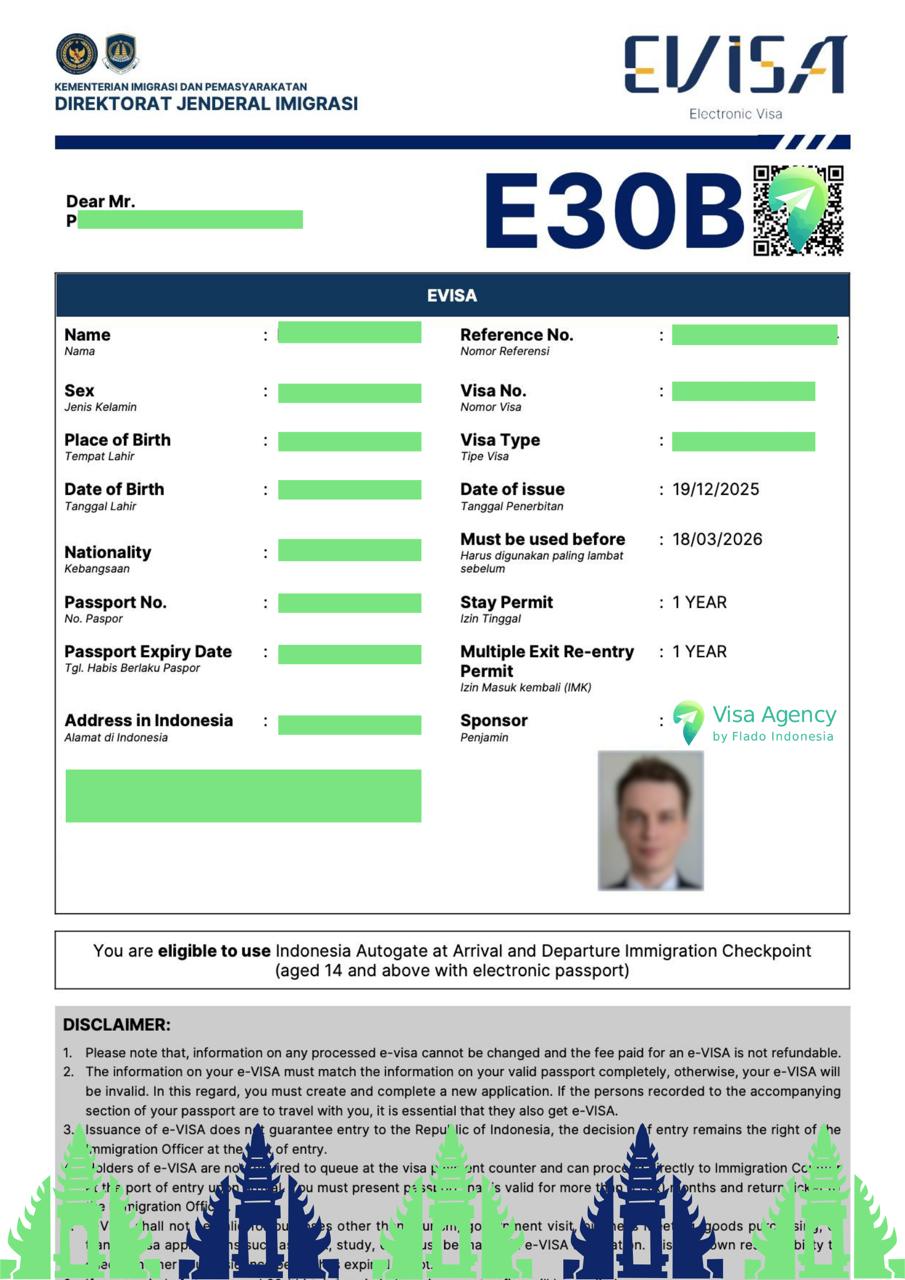
If the applicant is not a school student but is planning to study in higher education, then the relevant category is E30B, not E30A.
E30B is the student KITAS category for higher education in Indonesia. It covers:
- Undergraduate
- Postgraduate / Master’s level
- Doctoral / PhD level
Available formats include:
- E30B – Undergraduate, Postgraduate, and Doctoral Visa for 1 Year – KITAS
- E30B – Undergraduate, Postgraduate, and Doctoral Visa for 2 Years – KITAS
- E30B – Undergraduate, Postgraduate, and Doctoral Visa for 4 Years – KITAS
Who is E30B suitable for?
E30B is not a children’s school visa. It is intended for applicants entering higher education in Indonesia, such as a university, institute, college, or other recognised higher education institution.
For website guidance, it is better to describe E30B by study level rather than by fixed age. Still, a practical orientation can be given as follows:
- Bachelor’s / Undergraduate – usually from around 17–18 years old and above
- Master’s / Postgraduate – usually from around 21–22 years old and above
- Doctoral / PhD – usually from around 24–25 years old and above
So for SEO and practical explanation, the safe wording is:
This visa is generally suitable for adult students and young adults entering higher education in Indonesia, usually from around 17–18 years old and above, depending on university admission requirements.
If you are planning to study at university in Indonesia, we can also assist with this process. You can ask your university, college, or educational institution to contact Flado directly for support with the visa process.
E30A and E30B can also support family relocation planning
Many families do not move to Indonesia only for the child’s studies. They move for education, lifestyle, climate, family experience, and long-term residence planning. That is why student KITAS options are often connected with family immigration planning.
If the principal applicant qualifies for a student KITAS, we can also help structure related family options, including:
- Parent KITAS
- Sibling KITAS
- other family-based residence planning depending on the case
You can also explore:
- Student visa and education options in Indonesia
- Schooling and family KITAS options
- Family relocation to Indonesia for study and life
- Dependent KITAS for parents, brothers, and sisters
How long can E30A, E30B, and dependent KITAS be issued for?
In general, both E30A and E30B can be issued for 1 year, 2 years, or 4 years, depending on the sponsor’s structure and the study plan.
Dependent residence permits for family members are more limited. In practice, dependent KITAS usually cannot exceed 2 years, and many cases are commonly issued for 1 year or 2 years.
This is important for families who are planning schooling and residence together: the student’s main KITAS and the family members’ KITAS may not always have the same maximum duration.
What should families do now?
If your child is already in Primary School, Junior High School, or Senior High School, then E30A may still be the right route, as long as the school documents are correctly structured.
If your child is in kindergarten or preschool, then the situation is more limited under the current practice, and you should not rely on E30A as the default solution.
If you are entering higher education, then E30B may be the correct student KITAS category.
If your goal is to relocate with the whole family, it is best to look not only at the child’s age, but at the entire immigration strategy: the type of school, the sponsor, the education level, and the family residence options that can legally accompany the main applicant.
Final practical conclusion
As of 8 June 2026, the practical immigration interpretation for E30A Student Visa / KITAS is that it is currently suitable for students in SD, SMP, and SMA, which usually corresponds to approximately 6 to 18 years old.
The exact outcome depends not only on age, but on the type of educational institution and the school level written in the acceptance documents.
For university-level studies, the correct category is E30B, which covers undergraduate, postgraduate, and doctoral studies.
For younger children, especially kindergarten and preschool students, the situation is currently more restricted. That does not always mean there is no path at all, but it does mean families should ask for a case-by-case review rather than relying on old practice.