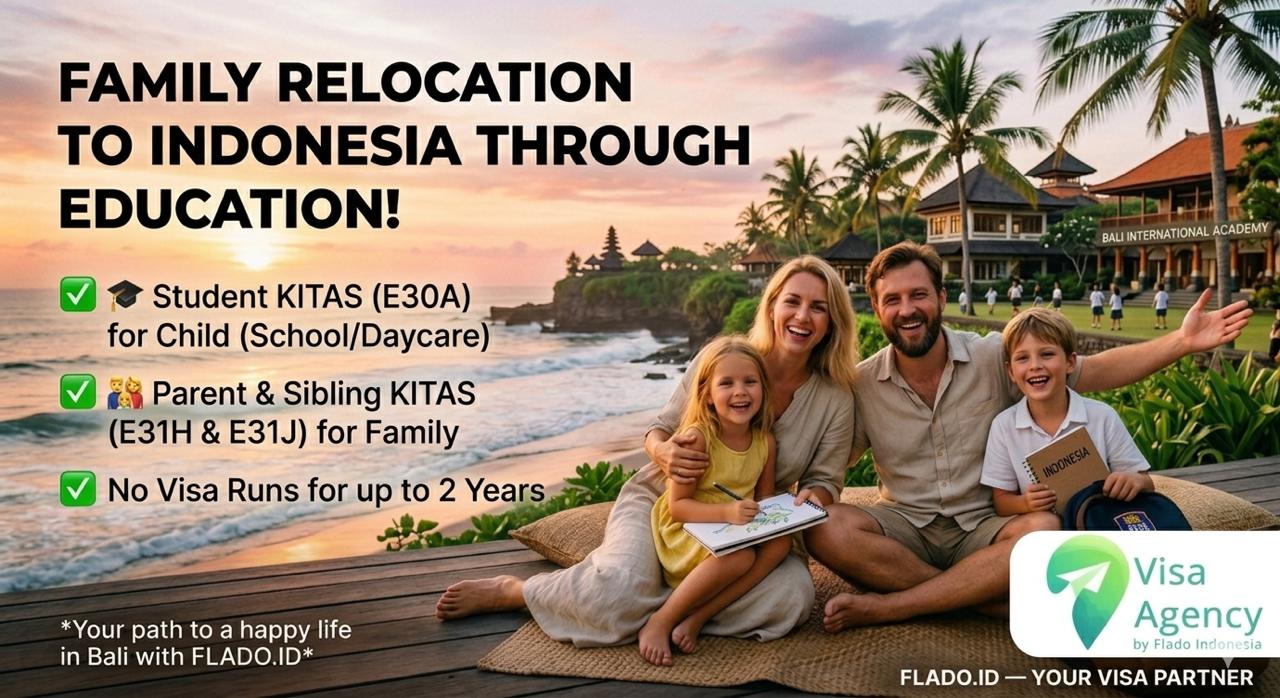
Moving to Indonesia with children usually starts not with a visa, but with choosing the right educational institution. If your child enrolls in a daycare, preschool, school, learning center or international academy in Indonesia, your family may consider a legal route through Student KITAS E30A for the child.
After the Student KITAS is issued, parents may be eligible to apply for Parent KITAS E31H, and the child’s brothers and sisters may be eligible for Sibling KITAS E31J. This format is suitable for families who want to live legally in Indonesia, plan education for their children in Bali, Jakarta or another region, and do not want to build their life around constant visa runs.
Choose a School or Kindergarten for Family Relocation
On the Flado Family Relocation page, you can view schools, kindergartens, preschools, learning centers and other educational institutions that may be useful for Student KITAS, Parent KITAS and Sibling KITAS planning.
Why Family Relocation Starts With Choosing a School
For the immigration process, it is not enough for a family simply to want to live in Indonesia. The legal basis is the child’s real enrollment in an institution that is ready to accept an international student and participate in the visa process.
That is why the first question is not which visa we need, but where the child will study, whether the institution matches the child’s age, location, program and whether it is ready to support Student KITAS.
In an ideal process, parents first choose the educational institution, then the school confirms admission and visa support, and only after that Flado helps build the right visa strategy for the whole family.
How the Student KITAS, Parent KITAS and Sibling KITAS Route Works
In the education-based route, the main applicant is usually the child. The child applies for Student KITAS E30A. After that, the parents may consider Parent KITAS E31H, while the child’s brothers and sisters may consider Sibling KITAS E31J.
It is important to understand that not every school automatically supports all types of family KITAS. Some institutions are ready to help only with the child’s student visa. Some operate through their own internal process. Some are already ready to work with Flado and support family applications in a more structured way.
That is why on https://flado.id/family it is important not only to view the school name, but also to send a request and check your specific family situation.
How the Process Is Structured: Parents, School and Flado
Applying for family residence through education is not just one form and not one document. Three parties are involved: the parents, the educational institution and the visa agency.
To avoid confusion, it is better to divide the process into three clear steps.
Step 1. Parents Contact the School
First, parents choose an educational institution from the directory and send a request directly. At this stage, it is important to understand whether places are available, whether the child’s age fits the program, what curriculum is used, which area the school is in, what language is used and whether the school is ready to act as a visa sponsor.
Flado cannot force a school to become a sponsor. For an educational institution, sponsorship is a voluntary decision. Therefore, the parents’ task is to choose a suitable place, discuss enrollment and receive confirmation of interest from the school.
Step 2. The School Confirms Enrollment and Visa Support
After the parents reach an agreement with the school about education, the educational institution should confirm its readiness to participate in the Student KITAS process. Usually, the school provides institutional documents, proof of the child’s enrollment, information about the study period and an understanding of how long it is ready to support the visa.
If the school already works with Flado, the process is usually easier. Flado helps with visa documents, sponsor letters, templates and online submission. For the school, this reduces the administrative burden, and for the parents it makes the process clearer.
Step 3. Flado Selects the Visa Strategy for the Family
When the school confirms its readiness to participate in the process, Flado moves to the visa part. We analyze where the family is now, what current visa the parents and children have, how many days remain before the current status expires, when school starts and how many family members need to be processed.
Depending on the situation, one of the following routes may be selected:
- Offshore — if the family is still outside Indonesia and plans to enter with the correct visas already issued.
- Onshore — if the family is already in Indonesia and the current status allows conversion to KITAS without leaving the country.
- Priority — if timing is limited and the family needs to meet the school year start, current visa expiry or planned relocation date.
The main goal is not simply to submit documents, but to choose a route that actually fits the family’s timeline, current status, children’s ages and the school’s readiness.
How to Choose a School by the Child’s Age
For family relocation, it is important to look not only at a beautiful school description, but also at the child’s age. The younger the child, the more important the location, logistics, daily routine and the possibility of continuing education in the same educational environment become.
If the Child Is Under 3 Years Old
For the youngest children, daycare, kids club, nursery, early learning programs or soft adaptation programs are usually considered. This option is convenient for families who are just relocating and want their child to gradually get used to a new environment, language and daily rhythm.
For parents, this is also an opportunity to choose the area of residence in advance and avoid changing it after only a few months. When choosing, it is important to check the minimum age, attendance schedule, language of communication and whether the institution can provide documents for Student KITAS.
If the Child Is 3–6 Years Old
For ages 3–6, families most often consider preschool, kindergarten, Montessori, Waldorf-inspired, international kindergarten or children’s educational centers.
This is one of the most popular ages for moving to Bali or Jakarta, because the family can choose a residential area around the kindergarten or preschool and then gradually move to primary school without a sudden change of environment.
If the Child Is 5–11 Years Old
For primary school age, the academic program, school stability, schedule, language of instruction, transport accessibility and the family’s long-term strategy already become more important.
If you plan to live in Indonesia not for one season, but for several years, it is better to look not only at the school for now, but also at the next stage of education. Ideally, the child can start with primary school and continue further without changing area, without a new adaptation period and without constantly looking for a new school.
If the Child Is 12–18 Years Old
For teenagers, choosing a school becomes even more strategic. At this stage, it is important to look at middle school, high school, academic pathway, university preparation, language of instruction, workload and school reputation.
Some large and well-known schools may be strong academically, but have their own internal visa process or support only Student KITAS without Parent KITAS. Therefore, parents should clarify in advance how exactly the school works with international students and whether it supports visas for the family.
Age-Based Choice: Where to Go With a Child Aged 1.5–7
If your child is between 1.5 and 7 years old, daycare, preschool, kindergarten or early development center will usually fit. Many parents hesitate to start relocation from a kindergarten because they wonder what will happen when the child turns 7.
In reality, this can be a normal strategy if the educational pathway is clear from the beginning. For example, a family may start with a kindergarten or preschool, receive a clear adaptation process, obtain a legal Student KITAS for the child and Parent KITAS for the parents, and then plan the transition to primary school or a K–12 international school in advance.
Example: Malinki Kindergarten as the First Stage of Family Relocation
Malinki Kindergarten in the Kerobokan / Canggu area can be a convenient first stage for families with young children. It is an international preschool / kindergarten for children aged approximately 1.5 to 7, with an English-speaking environment, Bahasa Indonesia support and Russian-speaking support.
For a family, it can be a practical starting point: the child goes through a soft adaptation, the parents choose a residential area, the family gets a clear educational pathway and may consider Student KITAS for the child through an educational basis.
The important point is this: if the child is already close to 7, the next step should be planned in advance. After kindergarten, the child will need to move to a school with a primary level or a longer educational pathway. That is why Flado recommends not choosing a kindergarten in isolation, but thinking immediately about where the child will go after it.
Practical Logic for the Family
If the child is 1.5–6 years old, the family can start with preschool or kindergarten, for example Malinki Kindergarten, if it fits the area, language, schedule and enrollment conditions.
If the child is close to 7, it is better to plan the next step in advance: primary school, international school or K–12 school, so that the family does not have to change the residential area at the last moment.
If the family has several children of different ages, it is important to choose not just the best kindergarten, but a full educational map: where the younger child will study, where the older child will study and which visa structure fits all family members.
What to Do After Malinki or Another Preschool
For a preschool-age child, preschool or kindergarten can be the first step. But if the family plans to live in Indonesia longer, the next stage should be considered in advance.
A possible logic may look like this:
- 1.5–7 years old: daycare, preschool, kindergarten, early development center.
- 5–11 years old: primary school or international primary program.
- 12–18 years old: middle school, high school, K–12 school or an international program with exam preparation.
This approach helps the family avoid a new school-search crisis every year. The family understands in advance where the child studies now, where the child can move next and which area is better for living.
Examples of Educational Pathways: From Preschool to K–12 School
Family relocation through education works better when parents look not only at the child’s current age, but also at the next educational stage. For example, if the child is now 2–6 years old, the family may start with preschool or kindergarten, and then plan the move to primary school or a K–12 international school in advance.
| Institution | Age and Format | Possible Role in the Family Pathway | Program |
|---|---|---|---|
| Malinki Kindergarten |
Approximately 1.5–7 years old Preschool, kindergarten, early development Kerobokan / Canggu |
Can be the first stage for a family with a young child: adaptation, choosing a residential area, starting the educational pathway and considering Student KITAS for the child. | Open PDF |
| Skyhawk Academy |
K–12 International school Tabanan / Buwit |
Can be the next stage after preschool or the main school route for a family looking for a longer educational pathway with an international program. | Open PDF |
What an Educational Pathway Can Look Like
For example, a family with a young child may start with Malinki Kindergarten at the age of 1.5–7, if this option fits the area, language, schedule and enrollment conditions. At the same time, the parents can already look at the next stage: primary school or a K–12 international school.
If the family wants a longer pathway, Skyhawk Academy can be considered as the next level for K–12 education, especially if an English-language educational program, international environment and preparation for IGCSE Cambridge exams are important.
The main idea is not to be afraid of starting with a kindergarten if it fits the child. It is important not to stop at one stage, but to build a map immediately: where the child studies now, where the child can move next and how the family’s visa strategy is built around it.
Other Institutions With Study Programs
The Flado directory also includes educational institutions whose study programs can be reviewed. This is convenient for parents: they can first look at the age, location, format and educational approach, and then send a request through the Flado Family Relocation page.
Important: the presence of a study program in the directory does not mean automatic approval of Student KITAS, Parent KITAS or Sibling KITAS. The final visa strategy always depends on the specific family, documents, current status, timing and the chosen school’s readiness to participate in the process.
| Institution | Area | Age and Format | Which Family It May Suit | Program |
|---|---|---|---|---|
| Bhumi Bali International School | Kerobokan / Bali |
Approximately 2–11 years old Preschool, kindergarten, primary school Cambridge Early Years / Cambridge Primary |
For families looking for a Cambridge-oriented route for early years and primary education. Before visa planning, it is necessary to separately clarify whether the school is ready to support the specific KITAS type. | Open PDF |
| Blue Dolphin PlaySckool Puri Gading and Kuta | Jimbaran / Kuta |
Approximately 18 months–6 years old Childcare, preschool, kindergarten PlaySkool / holistic early learning |
For families with young children looking for preschool or childcare in the southern part of Bali. This is a good example of an institution for an early educational start. | Open PDF |
| Empathy School | Bali |
Age to be clarified by request School / learning community |
For families looking for an alternative or community-oriented educational environment. Before visa planning, the age group, admission terms and readiness for Student KITAS should be clarified. | Open PDF |
| GROW International School in Kedungu | Kedungu / Tabanan |
Age to be clarified according to the program International school |
For families considering Kedungu / Tabanan and looking for a calmer area with an international educational environment. | Open PDF |
| Matahari Canggu | Canggu |
Approximately 6 months–6 years old Daycare, preschool, kindergarten, early learning Guided play / early learning |
For families with young children who live or plan to live in Canggu. For the visa part, it is necessary to clarify separately how the school works with foreign families. | Open PDF |
| Trehaus Jakarta | Jakarta |
Age available upon request Daycare, preschool, kindergarten |
For families considering a capital-city relocation scenario rather than Bali. In Jakarta, it is especially important to consider residential area, traffic and the family’s daily logistics. | Open PDF |
| Umalas Kids Club | Canggu / Umalas |
Approximately 6 months–6 years old Daycare, preschool, kindergarten British play-based Early Years curriculum |
For families choosing Umalas, Canggu or Kerobokan and looking for an early years program close to their place of residence. | Open PDF |
Compare Schools, Areas and Programs on One Page
In the Flado Family Relocation directory, you can choose the child’s age, area, institution type and send a request. This is the fastest way to understand which school fits your family and which visa route can be considered.
How to Choose a School by Area
In Bali and Indonesia, the area is often just as important as the school itself. If the child is young, daily travel through traffic can quickly become a serious issue for the whole family. That is why it is better to choose the school and housing together.
Kerobokan, Canggu, Berawa and Umalas
This cluster is often chosen by families who value an international environment, proximity to cafes, coworking spaces, children’s activities and the expat community. Here, families can look at preschools, kindergartens, learning centers and international school options.
The area suits families who want an active international environment, but traffic should be taken into account, and housing should ideally be chosen close to the school.
Sanur
Sanur is often chosen by families looking for a calmer rhythm, the sea, walkable infrastructure and a comfortable family environment. For younger and middle-age children, it can be a comfortable area, especially if the parents do not want to live in a very active tourist cluster.
Ubud and Surrounding Areas
Ubud suits families looking for a calmer, creative, nature-oriented or alternative educational environment. Here, Montessori, Waldorf-inspired, nature-based and community-oriented formats may be available.
But for the visa strategy, it is important not only to look at the school’s atmosphere, but also at its readiness to issue documents, cooperate with Flado or independently support Student KITAS.
Jimbaran and South Bali
Jimbaran and the southern areas of Bali can be convenient for families who value access to international infrastructure, proximity to the airport, beaches and calmer residential zones.
For families with children of different ages, it is especially convenient if the institution offers several educational levels: from early years to primary or higher. This helps avoid changing the residential area every year.
Tabanan, Buwit, Kedungu and Calmer Areas
Tabanan, Buwit, Kedungu and neighboring areas may suit families looking for a calmer environment, less urban noise and a more measured lifestyle. If the family is considering a K–12 school or a long-term educational strategy, these areas are also worth studying in advance.
For example, if the family is considering Skyhawk Academy or GROW International School in Kedungu, it is necessary to assess not only the school, but also the residential area, travel time, the child’s schedule and long-term household logistics.
Jakarta
Jakarta can be a practical choice for families who need the capital, a business environment, international schools, urban infrastructure and access to major educational institutions.
If the family is planning not an island relocation, but a more urban life in Indonesia, Jakarta may be a logical option. At the same time, the visa logic remains the same: the child enrolls in an educational institution, the school confirms admission and visa support, and then Flado helps with the KITAS strategy.
If You Want One of the Best Educational Institutions
Many families want to choose the best school immediately. This is understandable, but for family relocation it is important to look wider. The best institution is not only a strong program or a beautiful campus.
For a foreign family in Indonesia, it is important to check:
- whether the school fits the child’s age;
- whether places are available;
- which language of instruction is used;
- whether the school can issue an Acceptance Letter;
- whether the school is ready to support Student KITAS;
- whether Parent KITAS and Sibling KITAS support is possible;
- whether the school works with Flado or runs the process independently;
- whether there is a next educational level for the child;
- whether the area is convenient for the family’s life.
Sometimes it is more practical to start with a strong preschool or kindergarten and then move to an international school. Sometimes it is better to choose a K–12 school immediately if the child is already of school age. There is no single answer — the right strategy depends on age, area, timeline and the family’s visa situation.
If the School Supports Only Student KITAS
Some educational institutions may be ready to support only the child’s visa, but not the parents’ visas. This is especially important for families who want full family relocation.
If the school supports only Student KITAS, parents should discuss an alternative stay strategy in Indonesia with Flado in advance. In some cases, parents may need another type of visa or a separate visa structure.
That is why on the Family page it is important not only to choose a beautiful school, but to send a request and understand which visa route is available for your specific family.
If the School Already Works With Flado
If the school is already integrated into the Flado process or is ready to cooperate on visa support, family relocation is usually easier.
In this case, Flado can coordinate documents faster, check timelines, prepare sponsor letters, explain the process to the school and help the family choose the right route: offshore, onshore or priority.
For parents, this means less chaos and more predictability. For the school, it means less administrative workload. For the child, it means a smoother start to education.
Why You Should Not Be Afraid to Start With a Kindergarten
Some parents think that a kindergarten is too small a basis for serious family relocation. In practice, what matters is not the name of the institution, but its legal status, readiness to accept a foreign child, ability to issue enrollment documents and participate in the Student KITAS process.
If a kindergarten or preschool fits the child’s age and is ready to support the visa process, it can be the right first step. The main thing is to plan the next educational stage immediately, especially if the child is approaching school age.
Therefore, the logic may be as follows: first Malinki Kindergarten or another suitable preschool, then transition to primary school or an international school, while the family’s visa strategy is built around the child’s real educational pathway.
Start With Choosing a School, Not Guessing the Visa
Open the Flado Family Relocation page, choose the child’s age, area and suitable educational institution. Through the page, you can send a request and understand which combination fits your family: Student KITAS, Parent KITAS and Sibling KITAS.
Who Family Relocation Through Education Is Suitable For
This option may suit families who:
- plan to move to Bali, Jakarta or another city in Indonesia;
- want to live legally in Indonesia with their children;
- are looking for a preschool, kindergarten, school or international school;
- do not want to depend on short tourist visas;
- want to choose a residential area near the school in advance;
- plan a long-term educational pathway for the child;
- want to apply for Student KITAS for the child and check the possibility of Parent KITAS for the parents;
- want to understand whether Sibling KITAS is possible for brothers and sisters.
What Parents Should Do Right Now
If you are considering moving to Indonesia through your child’s education, start with three simple steps.
- Open the Flado Family Relocation directory and choose several suitable schools by the child’s age, area and education format.
- Send a request to the school and clarify whether it is ready to accept the child and support Student KITAS.
- After the school confirms, contact Flado or send a family request through the page so we can assess the visa strategy for all family members.
View Schools, Programs and Visa Support
Choose the area, child’s age, type of educational institution and send a request through the Flado Family Relocation page.
Family Relocation to Indonesia Should Be a Strategy, Not Chaos
Moving with children is not only about visas. It is about school, area, the child’s age, language of instruction, adaptation, documents, timelines and the family’s plans for the coming years.
Flado helps connect these elements into a clear route: choose an educational institution, check visa support, assess the possibility of Student KITAS, Parent KITAS and Sibling KITAS, and then guide the family through the process.
Start with the directory of schools and educational institutions: https://flado.id/family